The Tuned Pod: a senior team amplified by agents
How a small, senior team using AI agents ships what used to take a team three to four times its size — and keeps it running.
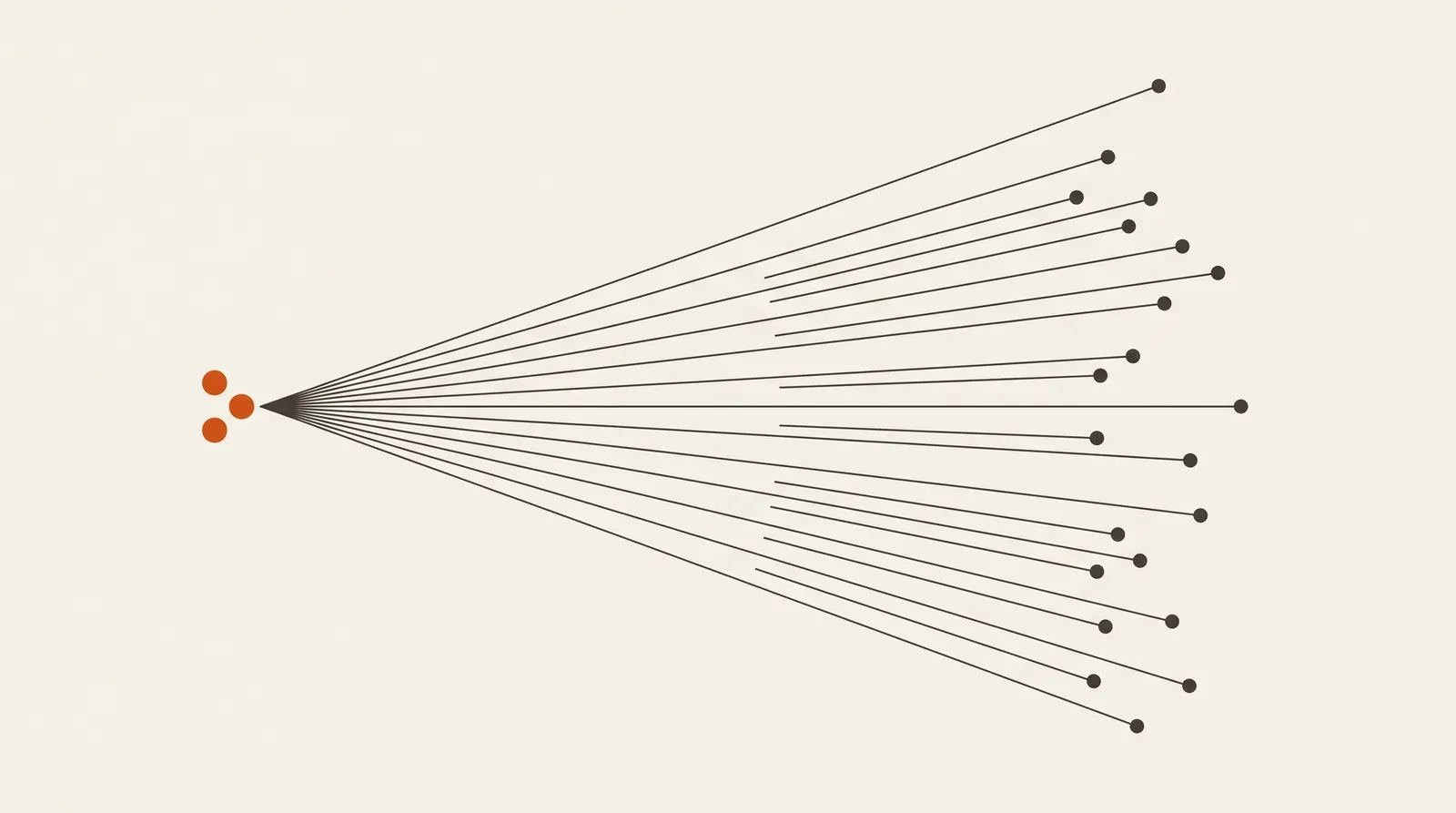
A Tuned Pod is a small, senior engineering team that uses AI agents to do the work a much larger team used to do — and stays to run what it builds. The model is simple: judgment is the scarce input, agents are the leverage, and a senior owner is accountable for the outcome end to end. It is how we ship production AI in weeks instead of quarters without trading away the trust that seniority buys.
Agents amplify judgment; they do not replace it
The mistake people make with AI-assisted engineering is treating the agent as a junior developer to be supervised. The better model is leverage: a senior engineer who knows exactly what to build directs agents to build it, reviews every decision that carries risk, and owns the result. The agent handles breadth and speed; the human handles judgment — the architecture calls, the trade-offs, the “no, that is subtly wrong” that only experience catches.
That division is why a Pod can move fast without moving recklessly. The output volume looks like a much larger team; the accountability looks like a single senior owner.
What a Pod actually is
A Tuned Pod has four properties:
- Senior-only ownership. Every Pod is led by an engineer who has shipped and operated production systems. There is no layer of juniors behind the brand.
- Agent-amplified throughput. Engineers steer in-house agent harnesses (built around the strongest available models) to handle the scaffolding, the boilerplate, and the breadth — so human time goes to the decisions that matter.
- End-to-end accountability. The Pod owns the outcome, from the metric it is meant to move to the system running in production.
- Embedded, fast. A Pod plugs into your stack within days and ships a working system in weeks.
Why small and senior beats large and layered
Large teams spend a surprising fraction of their effort on coordination — handoffs, alignment, and the overhead of many people touching the same system. A small senior team carries far less of that tax, and agents absorb the work that used to justify the headcount in the first place.
The result is not just speed. It is coherence: a system designed and built by people who hold the whole picture in their heads, rather than assembled from the partial views of a large team. Coherent systems are easier to trust, change, and operate — which matters most after launch.
Build-and-run, not build-and-leave
The Pod does not disappear at launch. AI systems drift: data shifts, usage patterns change, and the models themselves get updated underneath you. A system that was right on launch day needs ongoing attention to stay right. So a Pod stays to run what it built — monitoring the metric, catching regressions, and sharpening the system as reality moves. Building and leaving is how good launches quietly decay; building and running is how they compound.
The takeaway
The Tuned Pod is our answer to a simple question: what is the smallest, most senior team that can own a production AI outcome end to end? Agents make that team smaller than it used to be. Seniority makes its output trustworthy. And staying to run it is what turns a fast launch into a durable advantage.

Written by
ByteTuned Editorial Team
Senior engineers writing about building and running production AI.
Keep reading

How to evaluate a RAG system: the metrics that matter
Evaluate a RAG system in two halves: did retrieval fetch the right context, and did the model answer faithfully from it? Measure retrieval with context precision and recall, generation with faithfulness and answer relevancy — against a fixed set of test cases.
How to reduce LLM hallucinations in production
You cannot fully eliminate hallucinations, but you can drive them down with layers: ground the model in retrieved facts, constrain it with low temperature and structured output, validate with guardrails and an LLM judge, and measure the rate with evals.
How to cut LLM costs in production
Most production LLM bills can be cut 60–80% without hurting quality, because most requests are easy and do not need your most expensive model. The big levers: route to smaller models, cache repeated prompts, right-size, and trim context.
Building production AI? Let’s talk.
Book a 30-minute call. We’ll map the highest-impact system to build first — and what moving that number is worth.